Deuteronomy 6: The Most Important Passage for Christian Parents You Might Be Misreading
Deuteronomy 6: The Most Important Passage for Christian Parents You Might Be Misreading
When we were building our house several years ago, Sara and I had an idea about how to involve our girls in a meaningful way.
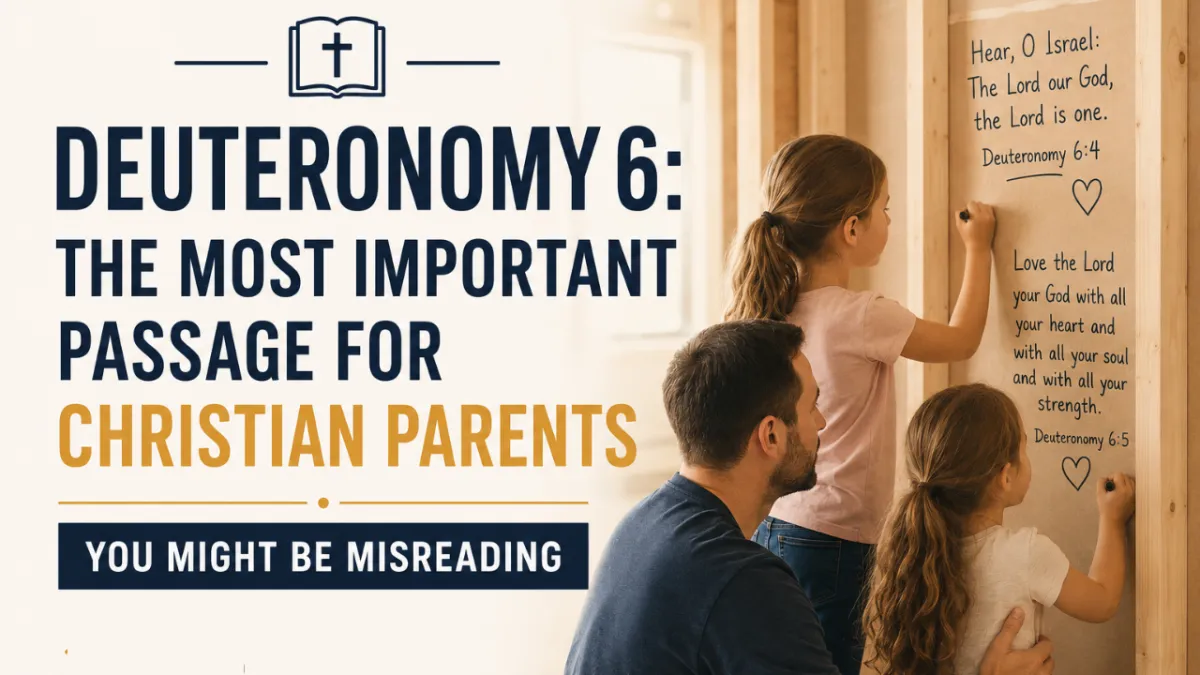
Before the drywall went up, we got out markers and wrote Bible verses directly on the studs. Every room in the house. Verses about God's faithfulness, about the home being a place of blessing, about raising children in the fear of the Lord. The kids helped. They chose the verses for their bedrooms.
Then the drywall went up and you couldn't see any of it anymore.
I've thought about that a lot since. The verses are still there, behind the surface, woven into the actual structure of the house. Nobody who visits our home will ever see them. But we know they're there. And in a strange way, that felt exactly right.
That's what Deuteronomy 6 is describing when it talks about what faithful parenting looks like.
What the Passage Actually Says
Deuteronomy 6:4-9 is one of the most important passages in all of Scripture for understanding what God has called parents to do.
It starts with the Shema: "Hear, O Israel: The Lord our God, the Lord is one." That's the foundation. Before any instruction about parenting or family life, there's a declaration about who God is and what allegiance He deserves.
Then comes the personal call: love the Lord your God with all your heart, soul, and strength. Before you can pass anything to your children, you have to be living it yourself. The relay race only works if the person running holds the baton.
Then the instruction for parents: these commandments are to be on your hearts. Impress them on your children. Talk about them when you sit at home, when you walk along the road, when you lie down, when you get up.
That's not a Sunday morning instruction. That's an all-day-every-day instruction. We wrote the Shema on the header above our front door.
What Most Parents Miss
Here's what I think Christian parents often unintentionally narrow in this passage.
We read Deuteronomy 6 and picture a formal devotional time. Dad opens the Bible after dinner, everyone sits nicely, there's a lesson and a prayer, and then the kids go to bed. That's not wrong. But it's a much smaller vision than what the passage is actually describing.
The text specifically mentions walking along the road, sitting at home, lying down, getting up. Moses is describing the texture of daily life, the ordinary moments, the transitions, the conversations that happen in the margins. The faith formation God is describing isn't primarily a scheduled event. It's a way of living that weaves truth into everything.
This connects directly to something I talk about a lot: the best moments of family connection and discipleship don't always happen when you plan them. They happen when you're present enough, and together enough, that they have room to occur.
The Relay Race
The image I keep coming back to for passing faith to the next generation is a relay race.
In a relay race, you don't win by running fast and then leaving the baton on the track for the next runner to pick up on their own. You have to be close enough to hand it off. The handoff requires proximity, timing, and intention. The next runner has to be ready to receive it.
Parenting as discipleship is the handoff. You can run a great race yourself, walk closely with God, know the Scriptures, be deeply faithful, and still drop the baton if you're not intentionally passing your faith to the next generation.
Deuteronomy 6 is the coaching manual for how that handoff happens. It happens in conversation. It happens in ordinary moments. It happens when the verses are on your heart and you're present enough that they find their way into the life of your family.
A Simple Place to Start
If this passage feels overwhelming, here's one concrete thing.
Write a verse somewhere in your home. On a whiteboard, on a piece of paper taped to the fridge, on the mirror in the bathroom where your teenagers get ready every morning. Something about identity in Christ, about God's faithfulness, about wisdom.
You don't have to write it on the studs. But put it somewhere.
Then talk about it. Not a lecture. Just a conversation. "Hey, I put this up because it's been on my mind. What do you think it means?"
That's Deuteronomy 6 in action. It's not complicated. It just requires you to be there and to care enough to start.
You already care. That's why you're reading this. Now go do something about it.
