
PILLAR ONE: TRUTH
Truth: Build your family on a biblical foundation.
Help your kids live out Scripture in real life, not just talk about it. Learn to have normal conversations with your kids about God and the Bible.
PILLAR ONE: TRUTH
Truth: Build your family on a biblical foundation.
Help your kids live out Scripture in real life, not just talk about it. Learn to have normal conversations with your kids about God and the Bible.
WHY IT MATTERS
Don't wait until they are adults to find out whether their faith stuck.
By then, it's too late to course correct. Lifeway Research found that 66% of young adults who regularly attended church as teenagers stop going for at least a year between ages 18 and 22. That's not a scare tactic. It's a reason to be intentional now, while your kids are still under your roof.
Lifeway Research, "Most Teenagers Drop Out of Church as Young Adults," January 15, 2019.
WHY IT MATTERS
Don't wait until they are adults to find out whether their faith stuck.
By then, it's too late to course correct. Lifeway Research found that 66% of young adults who regularly attended church as teenagers stop going for at least a year between ages 18 and 22. That's not a scare tactic. It's a reason to be intentional now, while your kids are still under your roof.
Lifeway Research, "Most Teenagers Drop Out of Church as Young Adults," January 15, 2019.
START HERE
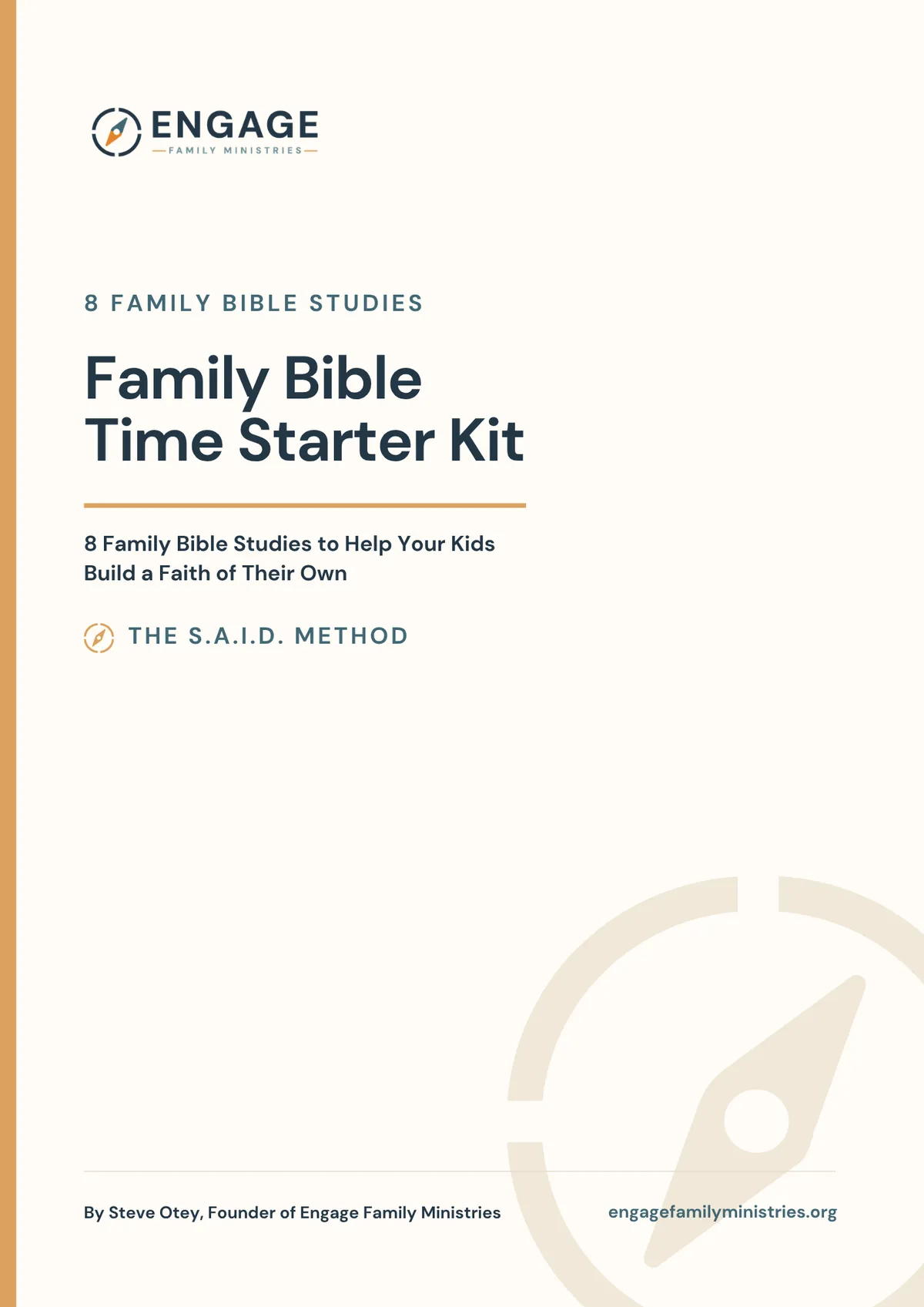
Family Bible Time Starter Kit
This free 8 week guide walks your family through the S.A.I.D. method. A simple way to study Scripture that's been used with teenagers for 30 years. It's a Bible study that teaches your kids a process of how to read the Bible.
FAMILY DEVOTIONS
The S.A.I.D. Bible Study Method
One of my mentors in college said he thought it was more important to be devoted than to do devotions. I think he was right. My hope for your family is that you'd grow in your devotion to Christ, not just check a box for having done family devotions. Whatever spiritual conversation looks like in your house: over the dinner table, or sitting down for a study together, Deuteronomy 6:4–9 paints a picture of a family talking about the truths of Scripture and the reality of God on an ongoing basis. That's the goal.
Family devotions can be a great tool for getting there, but they have a reputation problem: either they turn into a lecture, or they fizzle out after week two. S.A.I.D. is a simple, repeatable structure, borrowed from the classic observe–interpret–apply approach and adapted for families who want something they can keep doing without a curriculum.
S
Scripture. Read it out loud, together (or individually first if that works better for your house.)
A
Ask. All the questions. Kids and teens are naturally curious, so use it. Who's in this story? What happened? Why did they do that? What would it have felt like to be there? No question is off the table.
I
Interpret. What did this mean to the people who first heard it? What does it teach about God, and about people? How does the rest of the Bible help make sense of it? And only after that: what does it mean for us, today?
D
Do Something. Scripture isn't only meant to be understood: it's meant to change us. That could be an attitude, a choice, or a habit. Ask yourselves: because of what we just read, what's one thing we're going to do?
That's it. Four steps, and a little structure without overcomplicating it. Download the Family Bible Time Starter Kit to begin using S.A.I.D. at home.
START HERE
Family Bible Time Starter Kit
This free 8 week guide walks your family through the S.A.I.D. method. A simple way to study Scripture that's been used with teenagers for 30 years. It's a Bible study that teaches your kids a process of how to read the Bible.
FAMILY DEVOTIONS
The S.A.I.D. Bible Study Method
One of my mentors in college said he thought it was more important to be devoted than to do devotions. I think he was right. My hope for your family is that you'd grow in your devotion to Christ, not just check a box for having done family devotions. Whatever spiritual conversation looks like in your house: over the dinner table, or sitting down for a study together, Deuteronomy 6:4–9 paints a picture of a family talking about the truths of Scripture and the reality of God on an ongoing basis. That's the goal.
Family devotions can be a great tool for getting there, but they have a reputation problem: either they turn into a lecture, or they fizzle out after week two. S.A.I.D. is a simple, repeatable structure, borrowed from the classic observe–interpret–apply approach and adapted for families who want something they can keep doing without a curriculum.
S
Scripture. Read it out loud, together (or individually first if that works better for your house.)
A
Ask. All the questions. Kids and teens are naturally curious, so use it. Who's in this story? What happened? Why did they do that? What would it have felt like to be there? No question is off the table.
I
Interpret. What did this mean to the people who first heard it? What does it teach about God, and about people? How does the rest of the Bible help make sense of it? And only after that: what does it mean for us, today?
D
Do Something. Scripture isn't only meant to be understood: it's meant to change us. That could be an attitude, a choice, or a habit. Ask yourselves: because of what we just read, what's one thing we're going to do?
That's it. Four steps, and a little structure without overcomplicating it. Download the Family Bible Time Starter Kit to begin using S.A.I.D. at home.
WHAT YOU'RE REALLY PASSING ON
The 8 Checkpoints of Faith Formation
You already know you want your kids to "believe in Jesus." But if you had to name the specific things you're trying to pass on beyond that phrase, could you? These eight themes (adapted from Andy Stanley's Seven Checkpoints, with Identity in Christ added) are a starting point, not a rigid curriculum. The point isn't that your kids can recite all eight. It's that they hear them often enough that they sink in.
Authentic Faith
God can be trusted.
Proverbs 3:5–6
Spiritual Disciplines
When you see as God sees, you'll do what God says.
Romans 12:1–2
Moral Boundaries
God desires purity in every area, not just the ones we usually talk about.
1 Thessalonians 4:3–8
Healthy Friendships
Show me your friends, and I'll show you your future.
Proverbs 13:20
Wise Choices
God wants us to walk wisely and honor him in our decisions. Ephesians 5:15–17
Authority
Real freedom is found under God's authority, not outside it. Romans 13:1–2
Others First
Consider others before yourself.
Philippians 2:3–11
Identity in Christ
Identity drives behavior; who your kids believe they are shapes what they do.
Ephesians 2:10

WHAT YOU'RE REALLY
PASSING ON
The 8 Checkpoints of Faith Formation
You already know you want your kids to "believe in Jesus." But if you had to name the specific things you're trying to pass on beyond that phrase, could you? These eight themes (adapted from Andy Stanley's Seven Checkpoints, with Identity in Christ added) are a starting point, not a rigid curriculum. The point isn't that your kids can recite all eight. It's that they hear them often enough that they sink in.
Authentic Faith
God can be trusted.
Proverbs 3:5–6
Spiritual Disciplines
When you see as God sees, you'll do what God says.
Romans 12:1–2
Moral Boundaries
God desires purity in every area, not just the ones we usually talk about.
1 Thessalonians 4:3–8
Healthy Friendships
Show me your friends, and I'll show you your future.
Proverbs 13:20
Wise Choices
God wants us to walk wisely and honor him in our decisions.
Ephesians 5:15–17
Authority
Real freedom is found under God's authority, not outside it.
Romans 13:1–2
Others First
Consider others before yourself.
Philippians 2:3–11
Identity in Christ
Identity drives behavior; who your kids believe they are shapes what they do.
Ephesians 2:10